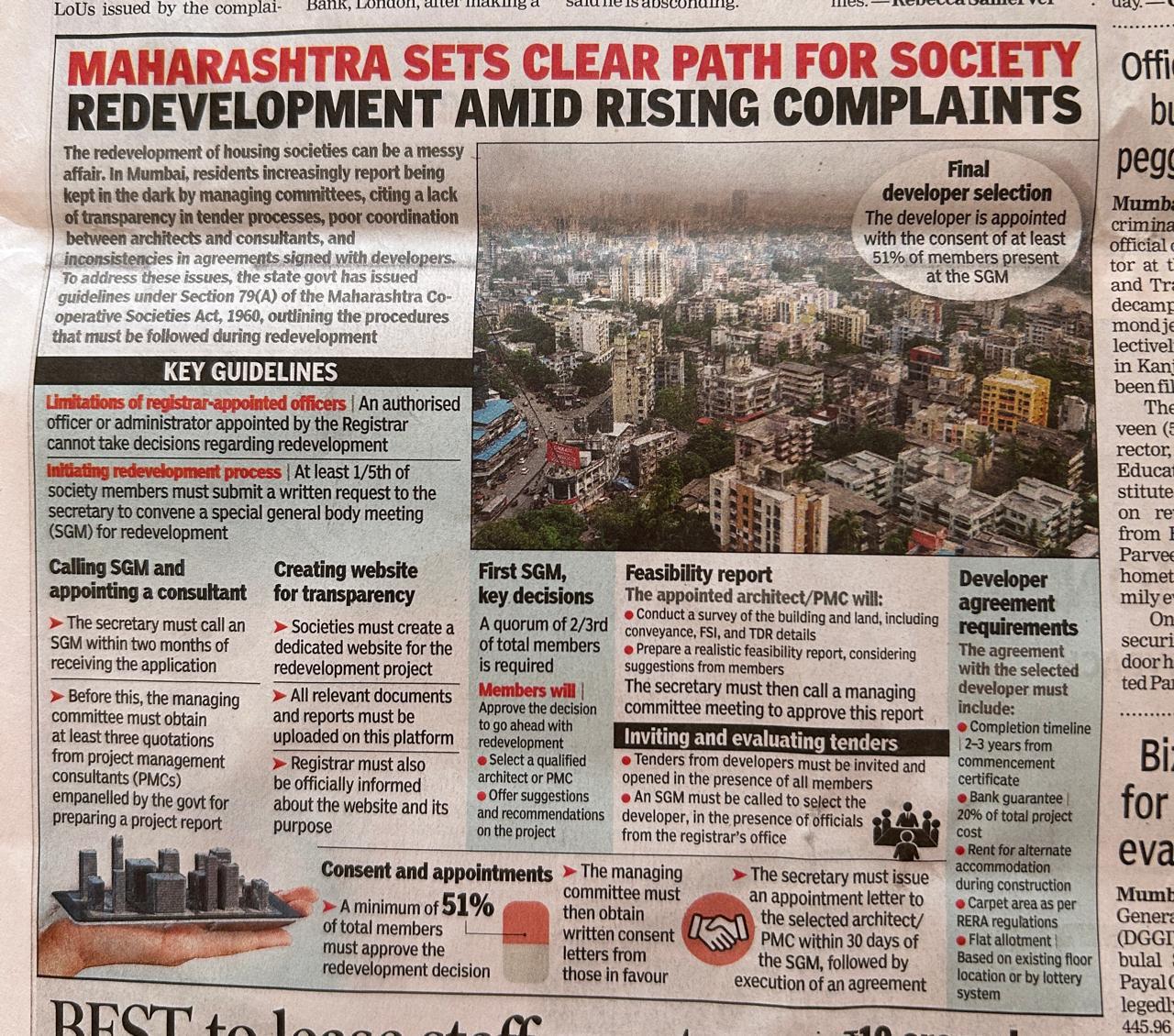
Maharashtra Government Introduces Clear Guidelines for Housing Society Redevelopment
Mumbai, India – To address rising complaints and bring transparency to the often-contentious process of housing society redevelopment, the Maharashtra state government has issued a comprehensive set of guidelines. These new directives, established under Section 79(A) of the Maharashtra Co-operative Societies Act, 1960, aim to create a structured, transparent, and fair framework for the redevelopment of aging buildings, particularly in cities like Mumbai where this is a frequent and complex undertaking.
The move comes in response to widespread reports from residents who felt marginalized by their managing committees. Many cited a lack of transparency in the selection of developers, opaque tender processes, poor coordination with architects, and inconsistencies in the final agreements. The new regulations are designed to empower society members and ensure that the redevelopment process is conducted with clarity and accountability.
As a reference, here is the original newspaper clipping that outlines these new government directives:
Key Pillars of the New Redevelopment Framework
The government's guidelines establish a step-by-step procedure that managing committees must now follow. These rules are designed to ensure that from the initial proposal to the final agreement, every stage is documented and approved by the society's members.
Here is a breakdown of the key stages as mandated by the new regulations:
- Initiating the Redevelopment Process
The process can no longer be initiated by a managing committee alone. It must begin with a written request from the society members themselves.
- Member-led Initiative: At least one-fifth (20%) of the total members of a society must formally submit a request to the secretary to convene a Special General Body Meeting (SGM) dedicated to discussing redevelopment.
- Calling the First Special General Meeting (SGM)
Once the request is received, the managing committee has a clear timeline to act.
- Timeline: The society's secretary is required to call an SGM within two months of receiving the application from members.
- Appointing a Consultant: Before this SGM, the committee must source quotations from at least three government-empanelled Project Management Consultants (PMCs) to prepare a detailed project report.
- Ensuring Transparency Through a Dedicated Website
To combat the issue of information being withheld, a digital-first approach is now mandatory.
- Mandatory Website: Every society undergoing redevelopment must create a dedicated website for the project.
- Centralized Information: All relevant documents, including feasibility reports, tender documents, and meeting minutes, must be uploaded to this platform for all members to access.
- Official Notification: The Registrar must be formally informed about the creation of this website and its purpose.
- The First SGM and Key Decisions
This meeting is a critical step where the society formally decides to proceed with redevelopment.
- Quorum: A quorum of two-thirds of the total members is required for this SGM to proceed.
- Member Approval: In this meeting, members will vote to approve the decision to go ahead with redevelopment, select a qualified architect or PMC, and offer suggestions on the project.
- Feasibility Report and Tender Process
The appointed architect or PMC will then conduct a thorough technical evaluation.
- Detailed Survey: This includes a survey of the building and land, along with details on conveyance, Floor Space Index (FSI), and Transfer of Development Rights (TDR).
- Realistic Report: The PMC will prepare a feasibility report, which must be approved by the managing committee.
- Open Tenders: Tenders for developers must be invited and opened in the presence of all society members and an official from the Registrar's office to ensure fairness.
- Final Developer Selection and Agreement
The final and most crucial decisions require significant consensus from the members.
- Member Consent for Developer: The final developer is appointed only with the consent of at least 51% of the members present at the SGM.
- Consent for Redevelopment Decision: A minimum of 51% of the total members of the society must approve the overall redevelopment decision. The managing committee must obtain written consent letters from all members in favor.
- Formal Agreement: The secretary must issue an appointment letter to the selected architect/PMC within 30 days of the SGM, followed by the execution of a formal agreement.
- Developer Agreement Requirements
The agreement signed with the developer must include several key protections for residents:
- Completion Timeline: A clear completion timeline of 2-3 years from the commencement certificate.
- Bank Guarantee: A bank guarantee equivalent to 20% of the total project cost.
- Alternate Accommodation: Provision for rent for alternate accommodation during the construction period.
- RERA Compliance: The carpet area must be as per RERA regulations.
- Flat Allotment: A clear system for flat allotment, either based on the existing floor location or a lottery system.
These new guidelines represent a significant step towards safeguarding the rights of residents and professionalizing the redevelopment landscape in Maharashtra. For legal professionals, understanding these regulations is crucial for advising housing societies and ensuring compliance at every stage of the process.
This article is based on information from a newspaper report. Credit is given to the original publication.